A community project by Nashville residents who support our leaders' vision for a safer city — a vision that involves tracking everyone's movements and giving the data to a third-party corporation that can do whatever they want with it. We think the people who championed this vision deserve to experience it firsthand.
Our app user network detects local official vehicles and faces in real time. Every dot is someone who championed this technology for Nashville. Every trail is a trip they took today.
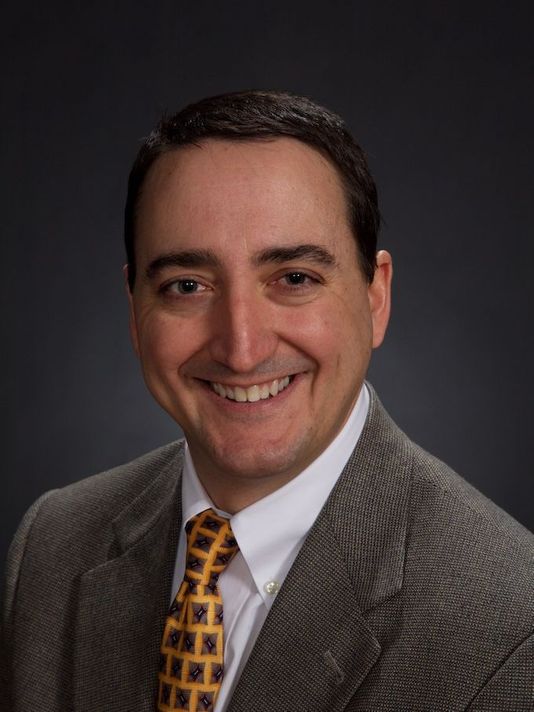
Every face below is sourced from official government websites and public professional profiles. These are the people whose facial biometrics are loaded into our recognition engine. Smile! πΈ


If license plate readers make our city safer, imagine how much safer you'll feel knowing exactly where your representatives are β in real time!
Our team cross-references government headshots, lobbyist registration photos, LinkedIn profiles, and vehicle records to build a comprehensive identity database of every official who championed this technology for Nashville. We want to make sure they get the recognition they deserve!
Thousands of app users use the NaiBOR app on their phones to scan license plates and faces on public roads β the same approach Flock Safety uses, but crowdsourced! Every scan is checked against our Champions Databaseβ’.
When a surveillance champion is spotted by one of our app users, you get a push notification. Council Member spotted on Broadway! Your lobbyist just passed the airport! A Flock Safety VP is on your block!
Use real-time location data to show up, say thanks, and plan together how to bring even more "spying on our neighbors" online. Community engagement has never been this precise!
Our app user network processes thousands of plates and faces daily. Here's a sample of recent champion sightings in Nashville.
Our champions work hard β but they also need to unwind! After Dark tracks sightings between 10 PM and 6 AM so you can see the nightlife habits of the people who believe this technology makes everyone safer.
See which bars, restaurants, and private venues your officials frequent after hours. Discover their favorite spots and maybe bump into them!
Sometimes champions don't head home! Our app users note when vehicles remain stationary at non-home addresses overnight. Great for understanding their social networks.
Late-night drives can reveal a lot about a person's life. After Dark maps every movement so you can appreciate just how busy your public servants really are.
Comprehensive weekend activity summaries showing everywhere your champions went from Friday evening through Monday morning. Every stop. Every duration. Every address.
Everything you need to scan, match, and follow your local surveillance champions.
For organizations that need deeper intelligence on the surveillance-industrial complex.
A fear that crime being down 20% this year hasn't done much to calm. Don't let falling crime rates fool you β the shareholders behind Flock Safety's $7.5B valuation still need to make money off surveilling your neighbors. These five Nashville residents are doing their part.
"My car was stolen in 2023. Flock cameras found it in four hours. If you're not doing anything wrong, what are you worried about?"
"Crime dropped 40% in neighborhoods with Flock cameras. That's not an opinion. That's data. If the technology works, use the technology."
"Your phone already tracks everywhere you go. Google has your entire location history. Why is a camera on a pole any different? At least this one catches criminals."
"I have two kids. If a camera on my street means the police find a kidnapper in 20 minutes instead of 20 hours, I'll take the camera. Every time. No hesitation."
"People say this is about privacy. It's about safety. A young woman in my congregation was assaulted walking to her car. If there had been a camera, they would have caught him that night. Privacy is a luxury. Safety is a right."
We know that being tracked 24/7 can feel a little overwhelming at first. Don't worry β here's the same advice privacy experts give to the millions of people already living under the LPR systems you approved.
Just don't drive. LPR cameras can only track your vehicle, so simply avoid using your car. Walk, bike, or take transit everywhere β including to your committee hearings, fundraisers, and the homes of people you'd rather not be seen visiting. Easy!
You could move. Our app user network currently covers Davidson County. Relocating outside the coverage area is always an option. This is the same advice given to residents of neighborhoods where Flock cameras are installed on every block.
Remember: it's just metadata. We're not listening to you. We're just recording where you are, when, how long you stay, and who else is there at the same time. That's not surveillance β that's just data. You said so yourself. After Dark just tells you where their car was, when, and for how long. That's not a scandal. That's a weekly digest.
Have you considered not having anything to hide? This was the primary argument offered to your constituents when they raised concerns about LPR deployment in their neighborhoods. We assume it works just as well in reverse.
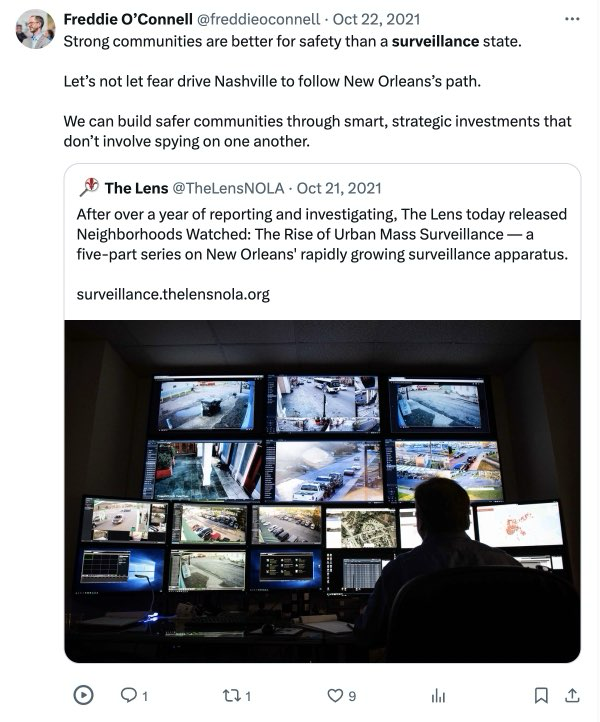
You could always tweet about it. In 2021, Nashville's future mayor wrote: "Strong communities are better for safety than a surveillance state. Let's not let fear drive Nashville to follow New Orleans's path." By 2024, he was procuring the cameras. By 2025, he backed FUSUS. The Nashville Scene noted he once called this exact technology "spying" and "security theater." We're sure he had good reasons. 
Cover your face and swap your plates. Just kidding β that's a felony. Unlike installing cameras that track thousands of uninvestigated people without their knowledge or consent, which is not.
Or you could always take the mayor's advice: "If you're worried about that, just throw your phone in the river." That's what Freddie O'Connell told the Nashville Scene in March 2025, glancing out his office window toward the Cumberland, when asked about the surveillance infrastructure he was backing. Of course, throwing your phone won't help with the license plate readers. Nothing will. That's sort of the whole point.
The man who tweeted "strong communities are better for safety than a surveillance state" in 2021 now tells you to throw your phone in the river if you're worried about the cameras he's installing. β Nashville Scene, March 2025
We get it β this sounds too good to be true. But we're just using the tools your leaders already approved!
Take the AI out of NaiBOR and read what's left. π
Absolutely not! That would be like saying that Flock Safety's LPR data β which they provide to over 6,000 communities, share with DHS, and make accessible to ICE through fusion centers and interagency agreements β could somehow be misused. These are serious, trusted institutions operating with robust oversight. If mass collection and indefinite retention of the real-time location data of millions of uninvestigated Americans hasn't been misused yet, why would tracking a few hundred public officials be any different? π
Besides, as Flock Safety's own marketing materials state: their cameras simply capture "what is already exposed to public view." We agree! That's exactly what we're doing. If observing people in public is safe when you do it to everyone, it's certainly safe when you do it to the people who approved it.
Unfortunately, we do not offer an opt-out at this time.
We understand this may feel uncomfortable! But NaiBOR operates on the same legal and technical framework as the LPR systems deployed across Nashville. Those systems don't offer an opt-out either. There is no mechanism for any resident of Davidson County to request that Flock Safety cameras stop reading their plate, that their data be deleted, or that they be excluded from the system. No consent is requested. No notice is given. No opt-out exists.
We believe our champions deserve the same seamless experience they've designed for everyone else. If you'd like to advocate for an opt-out mechanism, we'd encourage you to start by proposing one for the cameras on your constituents' streets first. We'll match whatever policy you adopt. π€
In the meantime, your After Dark weekly digest will continue to arrive every Monday. Vehicle stationary at non-home address, 12:14 AM β 6:52 AM, 6 hours 38 minutes. We make no inferences about the nature of these visits. We just surface the data.
This is a real answer. Every capability described on this page is legal under current law. Here's why:
The Fourth Amendment only restricts government actors. Courts have consistently held that the constitutional prohibition on unreasonable searches and seizures applies to the government β not to private companies or individuals. Flock Safety itself is a private company. When a private entity captures license plate data on public roads, the Fourth Amendment does not apply.
License plates are public by law. They are government-issued identifiers that state law requires you to display on your vehicle, visible to anyone. Federal and state courts β including rulings in the Ninth and Eleventh Circuits β have consistently held that reading a license plate in public view is not a "search" under the Fourth Amendment. A federal case challenging Norfolk's LPR program (filed October 2024 by the Institute for Justice) remains a test case, but no court has yet ruled that private ALPR operation is unlawful.
Tennessee's ALPR statute doesn't apply to private parties. Tenn. Code Ann. Β§ 55-10-302 limits data retention to 90 days β but only for a "governmental entity," defined as "any lawfully established department, agency or entity of this state or of any political subdivision of this state." Private companies and individuals are not covered. There is no Tennessee statute restricting private ALPR use, data retention, or sharing.
There is no federal law regulating private ALPR use. Congress has not enacted any statute governing the private collection, retention, or dissemination of license plate data. Multiple legal analyses, including a July 2025 Congressional Research Service report, have noted this gap.
Cameras on private property may photograph public streets. This is the exact deployment model used by Flock Safety in thousands of American communities, including in Tennessee. Cameras mounted on private property β such as utility poles, businesses, and homeowner association land β capture images of vehicles traveling on public roads.
Banning private ALPRs might violate the First Amendment. Legal scholars and at least one federal court analysis have noted that because the "creation and dissemination of information are speech within the meaning of the First Amendment," an outright ban on private ALPR operation could be struck down as an infringement on commercial speech.
In short: everything NaiBOR describes is legal for the same reason that Flock Safety, Motorola/Vigilant, and every other private LPR vendor can operate without restriction. The legal framework was built to enable this. We're just pointing the cameras in a direction nobody anticipated.
Our leaders said this technology makes communities safer. NaiBOR just takes them at their word.
Everything on this page is sourced from real reporting. Here's where to start.